TV Pop Diaries
Pop Music on British Television 1955 -
"This is what they want."
History now insists that Tiswas was the first decent Saturday morning show, and although it predates Swap Shop the debut honour would actually go to Ed and Zed or Zokko on the BBC.
ITV had an obvious gaping hole in their Saturday morning schedule, and had done so for years, but despite potential for the sale of advertising space it took until autumn 1973 for the schedulers to come up with a decent plan. London Weekend's Saturday Scene began in October, while on January 4th 1974 at 10.00 am on ATV 'Today Is Saturday or The Tiswas Show' debuted.
Until Tiswas came along, we all had a lie-
London Weekend were the first to really take the plunge with Saturday Scene in which
Sally James interviewed glam rockers in-
The hosts in the early years were John Asher, Peter Tomlinson, Trevor East (from
the sports presentation department), and on occasion Chris Tarrant, regular ATV news
reporter and schools telly voice-
Things started well for Today Is Saturday with a 7% share in the ATV area, quickly increasing to 23%. Talking to the Birmingham Mail in June 1974 Francis Essex of ATV expressed surprise at the initial success "... pretty remarkable going, by any standards." Essex claimed "We started off exploring this idea of a variation on the old Saturday morning children's cinema." Explaining the title he said "The title we decided on was Today Is Saturday. That started appearing on our typed schedules as 'T.I.S. was presented by...' 'T.I.S. featured...' and so on. One day Peter Harris, producing the show, had a brainwave 'Let's call the show Tis Was'." The show was billed as Today is Saturday in TV Times, but the staff referred to it as Tiswas. Harris would later go on to direct The Muppet Show for ATV.
But after eleven shows in March 1974 the show was dropped for unexplained "internal
difficulties." It would be back after the summer school holiday, starting with a
thirty-
The hosts wouldn't act like children as such but it was playtime, all the time, and they pretty much ignored the many children around them unless they were competition winners. And there would be many competitions, Under Eights, Over Eights (presumably anyone that was actually eight was forgotten about), Telephone Tricky Test Time, Which What Where, which filled up a lot of airtime, with prizes (records, books etc) presumably pilfered from the office.
In late 1974 TV Times would refer to the Tiswas Twins, Chris Tarrant and John Asher, and Trevor East with Tiswas Sportstime.
Talking to TV Times in February 1975 about its unexpected success Chris Tarrant claimed "Great hairy lads in pubs would come up to me and say 'never miss Tiswas'." The article also mentioned "Union troubles temporarily ousted it after only ten weeks. Yet it was talked about as if it had been running for years." The said article was actually about the London Weekend show Saturday Scene, hosted by Sally James. A portent of things to come.
The show's presentation was unique and didn't pander to needy executives who probably weren't watching anyway. Even in the early days the advert breaks would be referred to as "telly selly time", while messy custard pies which would need clearing up afterwards were very much evident, as was the reference to the studio home, ATV Land. In the TV Times in late 1975 Chris Tarrant was referred to as "Old Strawhead", Peter Tomlinson as "Poochie" and "Me Myself" Trevor East.
Expanding his horizons beyond news, schools programmes and Tiswas in 1976 Chris Tarrant
co-
Talking to the Birmingham Evening Mail in April 1977 producer Sid Kilbey claimed
" We don't patronise kids. We entertain them. There's no rehearsal. There are lots
of ideas and plans but about 80 percent of the talking is ad-
ATV presentation regulars would come and go for the first few years, but in an attempt
to persuade other ITV channels to take the show they brought in more familiar faces
from the outside. Outside in this case being London. Sally James, from the recently
deceased Saturday Scene, joined in September 1977 along with Jim Davidson who occasionally
appeared in sketches. Comedian Frank Carson would become an on and off regular for
several years, while Terry Hall and his friend Lenny The Lion, absent from TV for
many years also made an appearance. Tarrant was initially unhappy with James' inclusion,
but soon changed his mind when he recognised a kindred spirit. Sally would join Chris
Tarrant and Trevor East as a co-
The show would sometimes verge into Page Three territory. On one occasion, let's
be honest probably more than one occasion, the ATVLand address would be printed on
Sally's t-
The soaking that visitors, cast and crew got from buckets of water superseded the super soakers that would become popular with kids from the nineties onwards, while Frank Carson got hit so hard with a bucket of water by Chris Tarrant once that his glasses went flying off his head.
Talking to the BBC in 2006 ahead of the Tiswas Reunion TV show producer Glyn Edwards
confessed "I had worked as a teacher and a Punch and Judy man, so I knew that children
like to see knockabout fun and custard pie fun. Programmes didn't have to be so buttoned
up and strait-
In February 1978 producers tip off the press that Princess Anne and her then husband
Mark were in receipt of matching Tiswas T-
An essential part of the look of the show was the graphics of Chris Wroe, who also did the same for ATV's Revolver.
The show gave the world a classic and eternal piece of pop culture, its own dance,
The Dying Fly, in which the studio audience would lie on their backs kicking their
legs in the air. Tiswas friend Jasper Carrott had mentioned it to Chris Tarrant some
years before. The dance would be copied by the mainly punk teenage audience at ATV's
Revolver later in the year. It even had its own cash-
In spring 1978 Chris Tarrant (probably dressed in a rugby shirt and jeans) put out a request for anyone to come onto the show and stand in their newly constructed cage in a corner of the studio and have things thrown at them. They received eleven thousand letters. The cage, and the gunge tank above it, became a show regular until the end, with the cage sometimes containing the great and good of pop.
John Gorman from The Scaffold became a regular from 1978, playing various characters including The Masked Poet, Smello, Cabbage Face, PC Plod and the studio janitor, many of them rightly the subject of booing from the cast and crew. Later Bob Carolgees joined with notorious punk glove puppet Spit The Dog (who had his own Spit's Spot), and comedian/actor Lenny Henry, fresh from summer season, who brought bad jokes and dodgy impressions. This, indeed, is what they want.
Regular items now included Creepy Crawly Corner, later replaced by Cuddly Wuddly
Corner, then Creature Feature in which animals were brought into the studio which
was fine if they took the Blue Peter line and had just kept it to hamsters and gerbils,
but this being Tiswas, tiger cubs, cougars, an eagle, apes and bears were not out
of the question. On one occasion an armadillo got loose in the studio. Another regular
was Flan Your Folks in which kids get to win prizes much to their parents' physical
distress. Sally (The Fabulous Miss) James had her own Almost Legendary World Exclusive
In Depth Pop Profiles and Almost Legendary Pop Interviews (by the miracle of the
cathode ray tube), similar to her role on Saturday Scene, while Compost Corner gave
Lenny Henry the chance to do his David Bellamy impression. There were other regular
characters like the dreadful Phantom Flan Flinger and the even more mysterious piano-
There was no mystery that the cast wrote their own scripts, but on occasion others would contribute, Jasper Carrott among them.
By November 1978 even London Weekend was now taking it, but established fans didn't like the idea of the southern half of the country having what they have had all along. Talking to the Birmingham Evening Mail Chris Tarrant claimed "Some people have really changed their tune once they knew we would be seen in London. And that does irritate me. I'm delighted to get a national network slot but it's no great deal going to London. We'll just carry on in our own way." Not only was it now national, but international, judging by the number of letters they received from Ireland.
Various theme tunes would used over the years, with the version of Tiger Rag replaced by a specially commissioned song in September 1980, 'Saturday is Tiswas day', sung by Tom Bright and Suzi Breeze. Although it never relied on pop music the show had two hit singles of its own. The Four Bucketeers' Bucket Of Water Song produced by Neil Innes and a frightening version of Bright Eyes by the then five year old Matthew Butler.
The mixture of Saturday morning pictures misbehaviour, guest stars and pop clips
soon made it a necessity to watch. The series was finally networked in 1979 with
latecomers Southern TV finally allowing them in, while the show itself was attracting
names like Paul and Linda McCartney, Elvis Costello, the Two-
By late 1979 along with the cage stocks were introduced with a willing victim locked
up for the morning. A message on the continuity desk was now openly asking, or mocking,
"are you sure this is what you want!!" A new background musician was brought in to
accompany Porky, it was a one-
With the start of the 1980-
In 1980 they release an album Tiswas Presents The Four Bucketeers, featuring silly songs from the hosts, backed up by Timebox/Patto's Ollie Halsall, John Halsey, Clive Griffiths and Mott The Hoople's Morgan Fisher, with Neil Innes producing. The album came with an insert promoting Tiswas merchandise, something they didn't do on the TV show.
In January 1981 the Tiswas team appeared on stage at the Children's Royal Variety Performance. The team would also do a stage show, visiting campuses across the country in 1981.
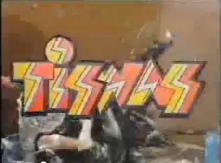
The letters that make up the title were meant to spell "Today Is Saturday, Watch And Smile", an idea suggested by a viewer, but as a placard on a later show claimed more realistically "This Is Saturday, Watch And Suffer" while another placard wished "Roll on World of Sport."
Another popular feature for the grown-
In true Blue Peter vs Magpie style you were either Swap Shop of Tiswas. The cool kids watched Tiswas and Swap Shop knew it. On the first show of 1981 someone is holding up a placard “boring old Edmunds.” "Edmunds" would get his own back by pinching the gunge tank for one of his own, much later shows.
During the first show of 1981, during a commercial break Sally James let something
slip. Addressing the cast she requested “Can I just tell everyone who’s doing the
OTT... so don’t do it on the wrong show.” On the final show on 28th March Sally let
the cat out of the bag again saying “when I come back on September 5th.” However,
they did go on tour together over the summer. They went out on the final show performing
The Death Of Heraclytus by Plato, first seriously (as it could get) and then the
light-
The unpredictable nature of the children-
Tiswas continued for a further series, beginning September 1981 with Sally James
now in charge (also given the new credit of Music Editor) with new co-
The new co-
The original show had evolved from merely a linking device to deservedly becoming
a show in itself, but now it was returning to a mere linking device again. The original
was inspired, the new version was contrived, like a step-
Chris Tarrant had instilled the sense that you were at some kind of drunken rugby club outing that had accidentally turned up at a children's birthday party. Undoubtedly Tiswas attracted the same fanbase and respect that Monty Python had, the show even played host to Pythons' Michael Palin and Terry Jones. At its best it almost looked as though the TV station that made it had never checked to see what they were doing, which is always for the best. Never forget, this was made by the same company that made Crossroads, and it's likely they never saw that either.
The blatantly obvious insurance risk, health and safety issues and changing societal attitudes mean that we will never see its like ever again. It was probably the only show that required viewer's to take a shower after watching it.
It's sad to report that very few of the original shows as broadcast exist, but Network
came to the rescue and released a DVD compilation of the three VHS titles released
in the early 1990s. Chris Tarrant managed to retrieve some off-
For the whole sordid story go to Tiswas OnLine. https://www.tiswasonline.com/
If you want to enter any of the competitions (underates and overates) then write to Tiswas, ATVLand, Birmingham, B1 2JP.
"We don't just fling this rubbish together, you know."
TISWAS
ATV
4th January 1974 -